Nepantla, the In-Between
When I was a freshman in college, I read Gloria Anzaldúa’s classic book Borderlands/La Frontera in an introduction to anthropology course. Her exploration of Chicanx culture—woven together with poetry, personal narrative, and reclamation—resonated with me in a way that made my heart race. A reckoning and recognition all at once. She examined how the Nahua concept of nepantla—a world of liminality and multiplicity of cultures and identities—often describes the Chicanx experience— “ni de aquí ni de allá”. For the course’s final paper, I ended up using Anzaldúa’s theories to write about my mother’s experiences with racism, identity, and art while growing up in Laredo, a border town here in Texas. My mother grew up as a first-generation Chicana, the 6th of 7 children to my Mexican immigrant abuela.

In writing that paper, it hit me that the concept of nepantla also captured my own lived experience as a Mexican-American woman navigating a predominantly white Ivy League institution (and later on a PhD program at UCLA). While I knew I had the smarts, grades, and drive to be in this rigorous academic world, comments from professors and classmates often implied that my presence was the result of affirmative action rather than merit. The tension I felt of my daily existence in the ivory tower—belonging and not belonging at the same time—felt like nepantla.
More recently, in my 40s, long past my academic years, I find that nepantla continues to describe my being, but now with spiritual meaning. When you step into the field of spirituality with the aim to help others heal, you are often not told that this process will urgently require your own spiritual excavation. It incites a continuous process of emotional realization, shedding of old patterns and reintegration. When I shared my frustrations and confusion with this process to a spiritual mentor, she guided me back to Anzaldúa and nepantla, reminding me that liminality is not a pause, it is an essential, dizzying part of spiritual growth. She likened nepantla to the way a spider builds a web—in circles with concentric rings. While you may be stuck in one part of the wheel of the web, the spider continues to move and create a stronger, circular foundation.
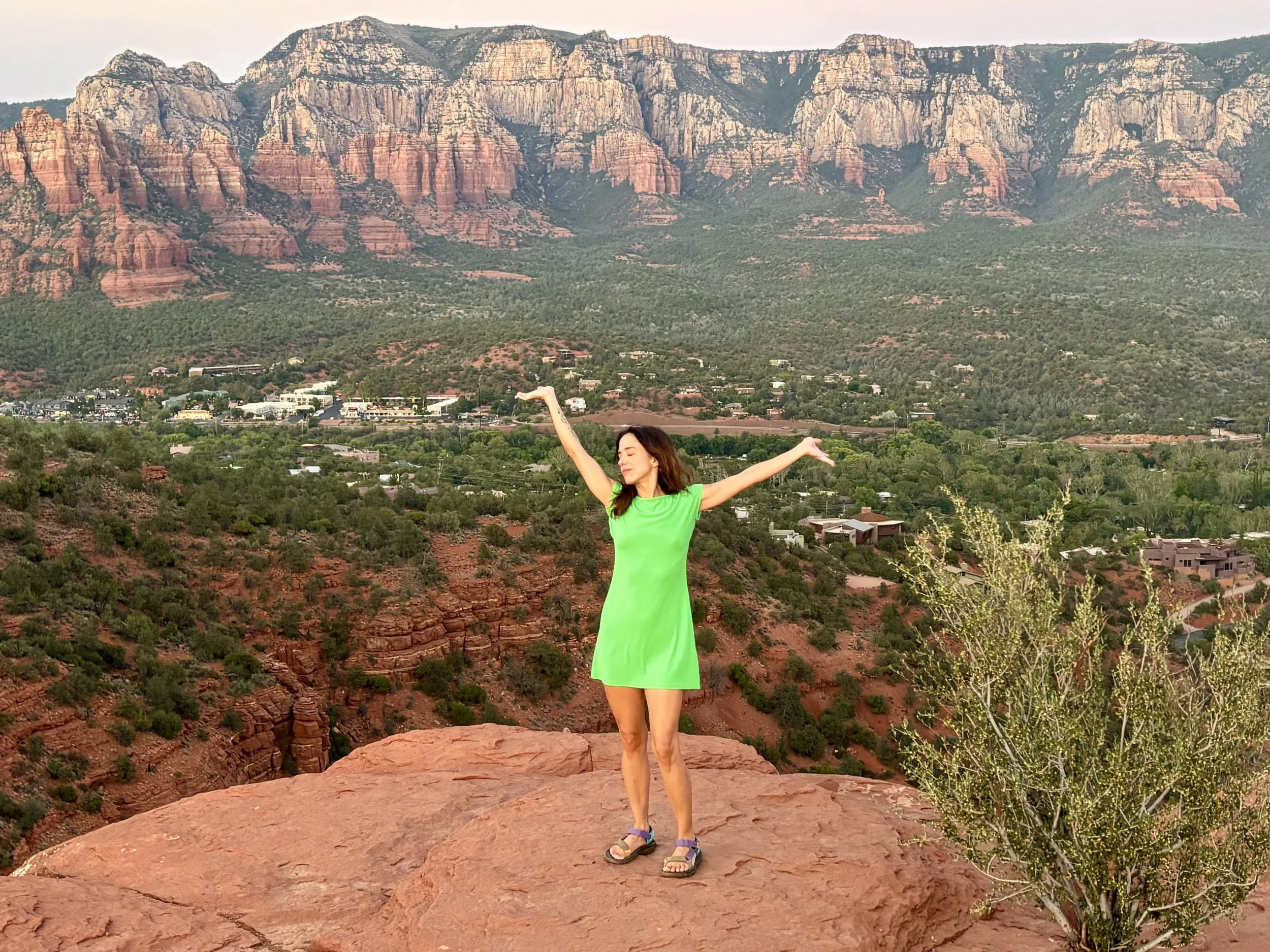
Me, in Arizona—an image that reminds me of nepantla
What I have come to embrace is that nepantla is a way of being, it is a multiplicity of existence—and it is impossible to rush through it. For the Nahua, nepantla meant the “space in-between”—a murky but authentic place of transformation. I know I am deep in nepantla when my inner state feels quiet, strange, and expectant. I often feel an inner churning of silence—as if the words I would formerly use to describe a situation or a feeling no longer work. As if they literally can’t even be voiced. Because a new way of experiencing and expressing is being agitated inside—a medicina of a new becoming.
Anzaldúa writes of nepantleras, or “bridge-walkers”, who learn to navigate the thresholds, the transitions from the shedding to the emergence. To live in nepantla is to inherently feel untethered, to let go of old ways of being, and to hold contradiction. Being a nepantlera means learning how to stay present while identities dissolve and reform. It requires holding multiple truths without forcing or fixing. In my own life, nepantla has appeared as grief, doubt, and awakening. Old narratives loosen their grip. Ancestral memory surfaces. Nepantla shows us that transformation is not linear; it is cyclical and spiraling, returning us to the familiar places with deeper awareness and greater compassion.
In my spiritual practice, I hope to show up with the power of a nepantlera—a bridge-walker of light and shadow—holding space between the conscious and unconscious, the fragmented and the whole. Nepantla reminds me that healing does not mean choosing one side over another, but learning to carry both with reverence. In this way, I hope that my clients can also be empowered by the in-between. Knowing that the in-between is a radical space not to escape but to embrace, a constantly evolving home of internal shifts, connection to roots, and gently cradling the unknown.